
2026-10-10 · Watch: Russia Disinformation
When a Russia disinformation watch filled the actor graph
One topic watch, one hub account, and a co-narrative ring: what Ofeux showed when structure appeared, not just volume. Ambient actors as opaque story codes.
One public topic watch. One account at the centre of a dense co-narrative ring. For the first time on this desk, the actor graph showed this much structure at once.
Most monitoring products stop at volume: how many posts mentioned Russia, how negative the average tone was. That misses the structure of a contested information environment. On Ofeux we listen through a Russia Disinformation topic profile, classify posts into narratives, then materialise an actor graph: who participates in which storylines, and who keeps showing up together.
In early October 2026, focusing one public account we label RUS-H produced a full ring of neighbours. Purple edges labelled co narrative tied that hub to dozens of other accounts. Edge weights on the visible links sat around three to four shared active narratives per pair: not a single viral post, repeated co-appearance across live storylines.
We refer to accounts here with opaque story codes (RUS-H, RUS-A1, RUS-C1, and so on), not platform handles. The map stays readable; people in the ring are not put on a public hit list.
That is the story: not a mention spike alone, but a map of who keeps landing in the same narrative threads.
What co narrative means here
On Ofeux, a co narrative edge is created when two actors both participate in the same active narratives on the watch. The number on the edge is the count of those shared narratives. Stronger multi-narrative overlap is more interesting than a one-off co-mention: it is a lead worth pulling on, not a smear.
It is not a follower graph. It is not, by itself, proof of coordination, shared funding, or a botnet. It is evidence of co-participation in the same live narrative clusters. That honesty is how this desk stays citeable.
The scene
| Metric | Snapshot |
|---|---|
| Watch | Russia Disinformation |
| Focus actor | RUS-H |
| Graph mode | Actor focus / investigation |
| Visible co-narrative weights | Mostly 3 shared active narratives; at least one edge at 4 |
| Neighbour cast | Dense ring of dozens of accounts |
| Role mix on ring | Amplifiers and counters both present |
The first read is simple: enough narrative overlap for structure to appear. Quieter watches often stay sparse; contested topic watches produce denser co-narrative maps.
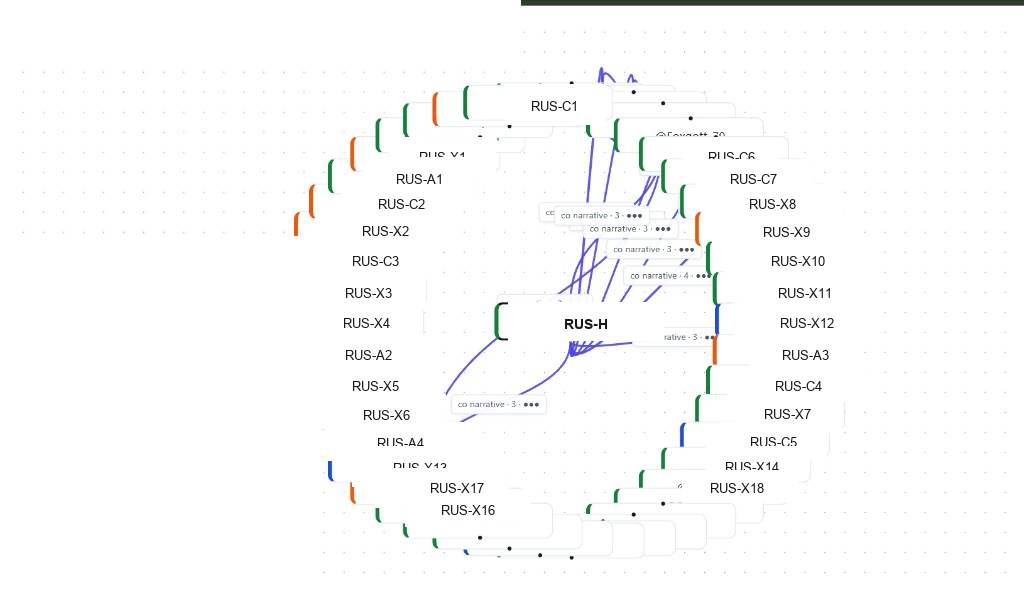
How to read this graph
- Green bar: Counter: pushed back against the framing on this watch.
- Orange bar: Amplifier: spread the framing without reframing it.
- Blue bar: Originator: seeded or started the framing (when present).
- Fuchsia bar: Catalyst: a post that pulled replies and drove the thread (when present).
- Yellow bar: Mutator: shifted the framing over time (when present).
- Indigo links: Co narrative edges: both accounts appear on the same active narratives. The number is how many they share (here mostly 3; at least one link at 4).
- RUS-H / RUS-A… / RUS-C…: Opaque story codes for accounts on the ring, not platform handles. H is the hub; A amplifier-leaning; C counter-leaning; X role still mixed or unclear in this cut.
Competing roles inside the same threads
The left-hand colour bar on each account is that dominant role on this watch: who seeds, amplifies, mutates, or counters a framing.
Around RUS-H the ring was not one colour. Amplifiers (spread without reframing) and counters (pushback) appeared in the same neighbourhood. That is the useful split for a disinformation watch: the fight is not only pro versus anti as a mood average; it is who is expanding a frame versus who is resisting it on overlapping storylines.
- Amplifier-leaning neighbours: RUS-A1, RUS-A2, RUS-A3, RUS-A4.
- Counter-leaning neighbours: RUS-C1, RUS-C2, RUS-C3, RUS-C4, RUS-C5.
Accounts that repay a closer look
Start with the hub, then the strongest co-narrative links. Weights below are shared active narratives with RUS-H (mostly 3; at least one link on the map reached 4).
| Public ID | Co-narrative weight vs hub | Why it matters |
|---|---|---|
| RUS-H | (hub) | Centre of the co-narrative ring |
| RUS-C1 | 3 | Counter-leaning neighbour on the ring |
| RUS-A1 | 3 | Amplifier-leaning neighbour; role contrast |
| RUS-A2 | 3 | Amplifier-leaning neighbour; role contrast |
| RUS-A3 | 3 | Amplifier-leaning neighbour; role contrast |
| RUS-A4 | 3 | Amplifier-leaning neighbour; role contrast |
| RUS-C2 | 3 | Counter-leaning neighbour on the ring |
| RUS-C3 | 3 | Counter-leaning neighbour on the ring |
| RUS-C4 | 3 | Counter-leaning neighbour on the ring |
| RUS-C5 | 3 | Counter-leaning neighbour on the ring |
| RUS-C6 | 3 | Same focus neighbourhood |
| RUS-C7 | 3 | Same focus neighbourhood |
The ring held more accounts than this table; these are the ones that best show the amplifier versus counter split around RUS-H.
What about the claims?
Structure came first in this window: who keeps co-appearing, and in which roles. The next question readers usually ask is which concrete claims rode those threads, and whether they hold up. Ofeux checks circulating claims against external evidence and labels them verified, disputed, pending, or unverifiable. Pending means we have not yet retrieved enough evidence; it is not a finding of falsehood.
If you want that claim layer on the same watch, or a private briefing on a subject you care about, reach us via www.ofeux.ai or hello@ofeux.ai. We publish field notes here; the live loop runs in the product.
What we learnt
- Structure beats volume: the interesting object was the co-narrative ring, not a single sentiment score.
- Role mix matters: amplifiers and counters sharing neighbourhoods is a different story from a one-sided pile-on.
- Co-participation is what the graph shows; it is not automatic proof of a coordinated network.
- We publish ambient actors as story codes so the map can travel without turning into a doxx list.
- This is the kind of field note we will keep shipping: sharp enough to cite, careful enough to trust.
Public discourse field note. Tracked live on Ofeux. See Corrections for our update policy.